
FGI Bulletin #31
Seeking Applicants for the 2030 FGI Code Revision Cycle
FGI is now accepting applications from professionals interested in contributing to the development of the 2030 FGI Codes for Planning and Design of hospitals, outpatient settings, and residential care and support settings.
Following the closing of the application window (end of the day on November 22, 2026), the Steering Committee of the 2030 FGI Code Revision Committee (CRC) will select and appoint applicants to serve as CRC members for the remainder of the revision cycle—a roughly three-year commitment. In addition to forming the CRC, the Steering Committee will identify and form subcommittees based on priorities established for the 2030 revision cycle.
FGI welcomes applicants from across the health and residential care community, including owners, planners, designers, clinicians, infection preventionists, engineers, facility managers, researchers, authorities having jurisdiction, and other subject matter experts (SMEs). Some applicants may be selected to serve on the CRC, while others may be asked to serve as subject matter experts on subcommittees formed to address specific topics across the FGI Codes. Both roles are critical to the revision process.
To be considered for the 2030 CRC, applicants must complete the application form and upload a current résumé before the end of the day on November 22, 2026.
CRC membership will not be finalized until mid-winter, and applicants can expect final application status from FGI before the end of the first quarter of 2027. Additionally, opportunities for SME participation may be identified throughout the revision cycle. We look forward to hearing from you!
Celebrating the People Behind the 2026 FGI Codes and Handbooks

The release of the 2026 FGI Codes for Planning and Design and FGI Handbooks for Planning and Design marks the culmination of more than four years of work—and an achievement made possible by the extraordinary contributions of the 2026 Health Guidelines Revision Committee.
FGI leadership and staff extend their sincere thanks to the committee members and leaders, volunteers, and subject matter experts who contributed their time, knowledge, and wisdom throughout the revision process. Without your expertise and commitment, it would be impossible to continue revising the FGI Codes.
Developing a new edition requires more than technical expertise. It requires collaboration, thoughtful debate, careful consideration of new and evolving needs, and a shared commitment to improving the environments where care is provided.
We are deeply grateful to everyone who contributed to the 2026 edition. Thank you for the time, energy, and expertise you so generously gave to take the 2026 FGI Codes and Handbooks from possibility to reality.
Errata Available for Multiple Editions of the FGI Codes/Guidelines
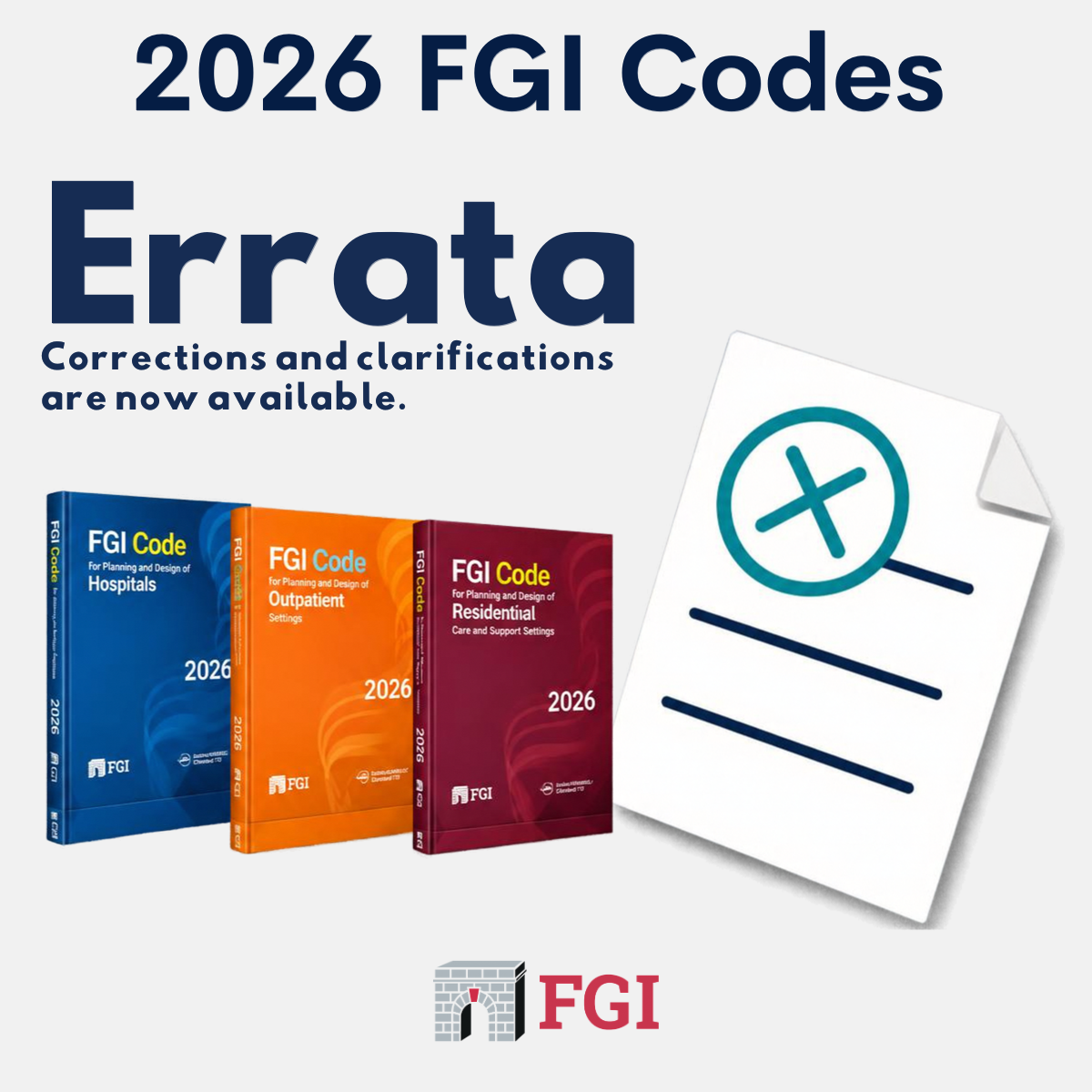
FGI has published new errata for the 2026 editions of the FGI Codes for Planning and Design of hospitals, outpatient settings, and residential care and support settings. In addition, updated errata sheets have been made available for the 2022, 2018, and 2014 editions of the Guidelines.
Users of printed editions are encouraged to review the applicable errata sheets and download them for future reference. View printable errata sheets here.
For subscribers accessing the FGI Codes/Guidelines through OneSource, all published errata are incorporated into the documents and are identified as such in the platform.
Be sure to check the Errata and Addenda page on the FGI website regularly to stay current with the latest corrections.
Kirsten Waltz Appointed to FGI Board of Directors

FGI is pleased to welcome Kirsten Waltz, MArch, FAIA, FACHA, to its Board of Directors. Kirsten, Vice President of Architecture and Planning for Johns Hopkins Health System, brings more than 25 years of architectural experience and a longstanding commitment to FGI and the advancement of health care planning and design.
Kirsten is well known to the FGI community. She served as one of three chairs of the Guidelines for Design and Construction of Outpatient Facilities for the 2018 and 2022 revision cycles and led development of the 2026 FGI Code for Planning and Design of Hospitals. Her experience with FGI’s consensus-based process and her commitment to using credible research to improve operational and functional outcomes will bring an important perspective to the FGI Board.
“I’ve been fortunate to contribute to FGI’s work over several revision cycles, and I’m excited to serve the organization in a new capacity,” Kirsten says. “FGI has an important opportunity to build on its strong foundation while continuing to evolve with the needs of the health care community, and I look forward to helping shape that next chapter.”
FGI Board President Tina Duncan, AIA, CBO, ACHA, also welcomed Waltz to her new role. “Kirsten has been an important part of FGI’s work for many years, and she understands both where we’ve been and where we have the opportunity to go next,” Tina says. “Her leadership, experience, and commitment to evidence-based health care design will be invaluable as FGI builds on its strong foundation and moves into its next era.”
At Johns Hopkins, Kirsten oversees master planning, programming, and architectural design for Johns Hopkins Health System and the Johns Hopkins University School of Medicine. She is a past president of the American Institute of Architects Academy of Architecture for Health, is actively involved with the Center for Health Design, and holds Evidence-Based Design Accreditation and Certification.
Get More from OneSource with the Customer Help Center

It’s been just over a month since FGI launched the 2026 FGI Codes and Handbooks for Planning and Design and OneSource, our new digital platform that brings all available FGI resources together. As customers explore the new platform, their questions and feedback are helping us better understand how they use OneSource and where additional guidance can make their work easier.
To support the user experience, OneSource features a Customer Help Center with practical resources to help you and your team get the most from the platform.
Whether you’re learning the platform yourself, onboarding new team members, or managing access for an organization, the OneSource Customer Help Center puts guidance in one place so you can find answers quickly and help your team use FGI resources consistently and effectively.
Customer Help Center Highlights
- Get started quickly with guided videos and onboarding resources.
- Watch step-by-step demonstrations to learn how to access and navigate FGI content.
- Explore collaboration tools, including sharing, team workspaces, and custom project folders.
- Manage subscriptions with guidance on purchasing, licensing, and account administration.
- Find answers quickly with troubleshooting and support resources for common questions.
Visit the OneSource Customer Help Center here.
Plumbing Changes, Explained
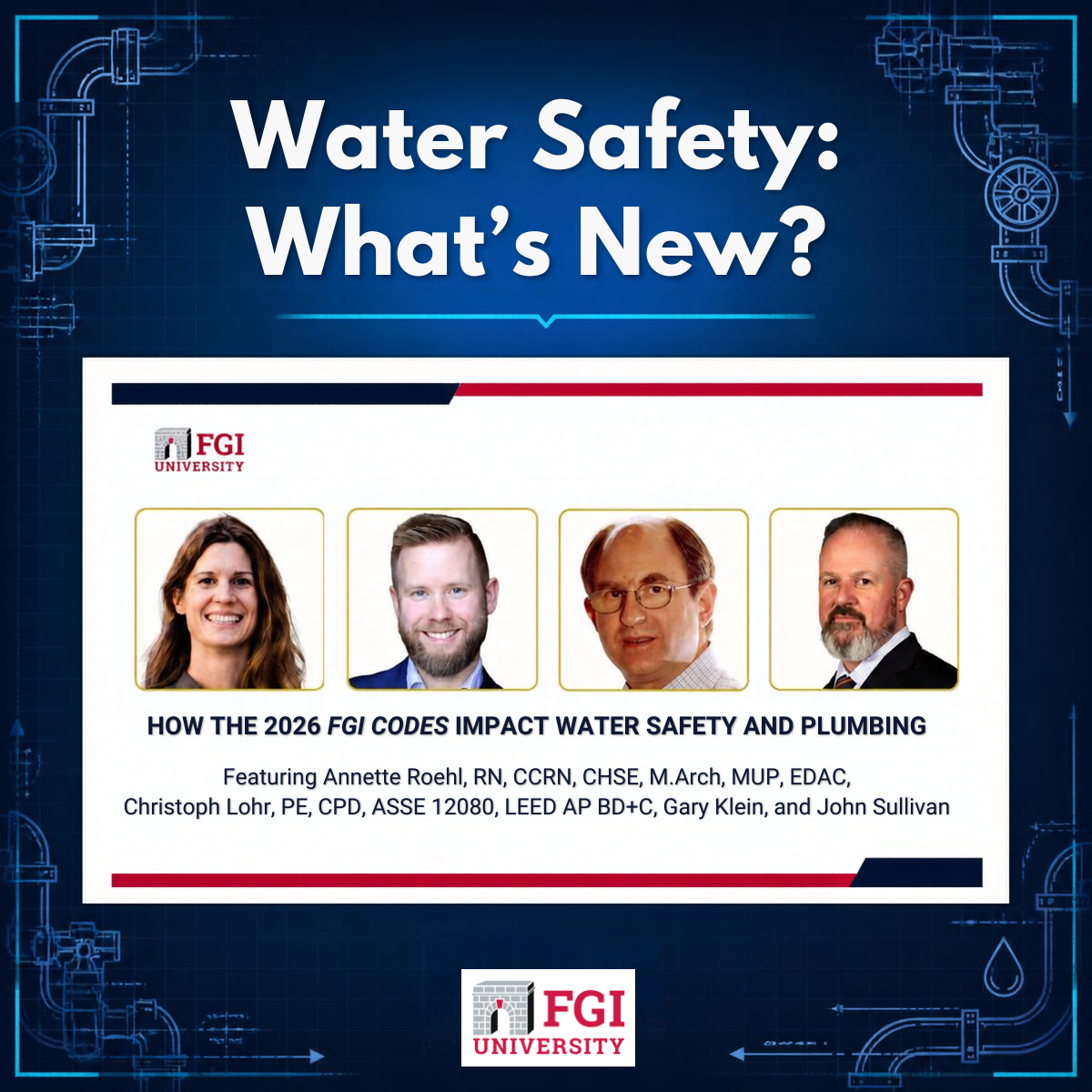
In case you missed it, members and subject matter experts from the 2026 Health Guidelines Revision Committee’s (HGRC) Plumbing Task Group recently participated in a live webinar during which they examined changes in the 2026 FGI Codes affecting water safety and plumbing systems.
The panel featured four experts who contributed to the development of the 2026 requirements:
- Christoph Lohr, PE, CPD, LEED AP BD+C, ASSE 12080, Vice President of Strategic Initiatives at the International Association of Plumbing & Mechanical Officials, 2026 HGRC member, and chair of the 2026 Plumbing Task Group
- Annette Roehl, RN, CCRN, CHSE, MArch, MUP, EDAC, Nursing Operations and Project Manager at Froedtert Hospital and member of both the 2026 HGRC and 2026 Plumbing Task Group
- Gary Klein, President of Gary Klein and Associates, Inc. and member of the 2026 Plumbing Task Group
- John Sullivan, Instructor at the Plumbers Local One Trade Education Fund and member of the 2026 Plumbing Task Group
The panelists shared technical considerations behind the updated requirements and discussed their implications for health care facility planning, design, and operations. Topics included water quality and water age; flow rates and low-flow fixtures; Legionella risk mitigation; splash reduction techniques; and medical gas system updates.
More than 50 participants joined the live discussion. The recorded session is now available through FGI University, offering an opportunity to hear directly from the experts who helped develop plumbing-related FGI Code requirements and better understand the changes from the 2022 to 2026 editions.