
FGI Launches 2026 FGI Codes and Handbooks and Introduces FGI OneSource
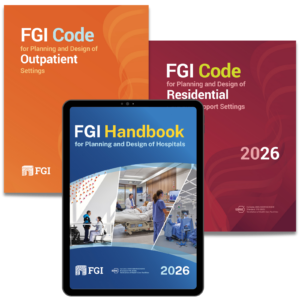
FLORENCE, MA – FGI today released the 2026 FGI Codes for Planning and Design and the new FGI Handbooks for Planning and Design, the latest evolution of consensus-based requirements and supporting resources used in the planning and design of hospitals, outpatient facilities, and residential care and support settings.
The release also marks the launch of FGI OneSource, FGI’s new digital platform for accessing its publications and technical resources.
The 2026 editions reflect the continued evolution of health and residential care delivery and introduce a new way of organizing and presenting FGI’s requirements. For the first time, the FGI Codes focus exclusively on minimum planning and design requirements. Explanatory and advisory material previously published in appendices has been expanded and incorporated into the new digital FGI Handbooks, which contain the complete text of the corresponding FGI Codes along with helpful guidance, diagrams and graphics, planning considerations, and resources.
“The 2026 edition represents an important step in the continuing evolution of FGI’s work,” said Heather Livingston, CEO of FGI. “Health and residential care environments continue to change, and the professionals who plan, design, and renovate them need both current consensus-based requirements and a clear understanding of the considerations behind those requirements. The new FGI Codes and Handbooks allow FGI to serve those distinct needs while keeping the information closely connected.”
2026 FGI Codes Address Changes in Care Delivery
The 2026 FGI Codes were developed through a rigorous, interdisciplinary consensus process involving hundreds of volunteers from across the health and residential care design community. Architects, engineers, clinicians, facility representatives, authorities having jurisdiction, and other subject matter experts worked together to evaluate proposed revisions, consider technical evidence and practical experience, and respond to proposals and public review and comment.
“Every edition of the FGI Codes represents thousands of hours of discussion, research, review, and collaboration by professionals who bring very different perspectives to the table,” said John Williams, chair of the FGI Code Revision Committee and vice president of content and outreach for FGI. “Our work on the 2026 edition was grounded in a shared responsibility to examine how care is changing and determine where the minimum requirements needed to change with it. The results reflect not one discipline or point of view, but the collective expertise and careful deliberation of the entire committee.”
Significant Changes
The 2026 FGI Code for Planning and Design of Hospitals responds to changes in both care delivery and the operational demands placed on hospitals. New minimum requirements address medical psychiatry units, rural emergency hospitals, discharged patient waiting facilities, and incident command centers, bringing several emerging or increasingly important facility types and spaces into the FGI Hospital Code. The edition also strengthens requirements affecting staff safety in behavioral and mental health units and emergency departments and includes technical revisions addressing waterborne pathogens, casework and surfaces, mobile units, and other elements of the patient care environment.
The 2026 FGI Code for Planning and Design of Outpatient Settings reflects the continued expansion and specialization of care outside the hospital. New chapters establish minimum requirements for short-stay centers and sleep disorder centers, while expanded provisions for behavioral health crisis centers distinguish community-based centers from those associated with freestanding emergency departments. The edition also introduces greater flexibility in areas for clean supply, while revising requirements for mobile units, birth centers, plumbing systems, surfaces, and specialty clinical spaces.
The 2026 FGI Code for Planning and Design of Residential Care and Support Settings represents a significant shift toward clearer, more prescriptive minimum requirements for residential settings. Most notably, the FGI Residential Code establishes single-resident rooms for at least 90 percent of resident rooms in several residential setting types, with provisions for AHJ-approved exceptions, and introduces a new chapter for residential behavioral and mental health treatment facilities. New requirements also address hemodialysis treatment rooms and accommodations for peritoneal dialysis in nursing homes, while revisions to dining, activity and community spaces, individuals of size, storage, environmental safety, and wayfinding address a broad range of residential care needs.
New FGI Handbooks Add Context and Technical Resources
The new FGI Handbooks for Planning and Design provide a companion resource for professionals who need additional context for the minimum requirements, providing the context, commentary, and technical resources that support their application. By separating minimum requirements from explanatory and advisory material, FGI has created a clearer distinction between what is required and the additional information that can help professionals understand the intent and considerations behind those requirements.
The FGI Handbooks also include the new Clinical Risk Assessment Tool (C-RAT), a guided resource designed to prompt interdisciplinary discussion when determining what type of room is needed based on the clinical services that will be performed. Also included are checklists for rooms in the 2026 FGI Hospital Code. These checklists are designed to help project teams identify and review the FGI requirements that apply to individual room types by bringing relevant requirements together in one resource and providing a practical reference for use during planning, design, and project review. Checklists for rooms in the 2026 FGI Hospital Code are available at launch, with checklists for the 2026 FGI Outpatient and Residential Codes under development.
The digital FGI Handbooks will be maintained on a continuous basis, allowing FGI to regularly update and expand explanatory guidance, illustrations, tools, and other supporting resources as new information becomes available. This ongoing approach allows the FGI Handbooks to remain current between the four-year publication cycles of the FGI Codes while preserving a clear distinction between the minimum requirements established in the FGI Codes and the supplemental resources provided in the FGI Handbooks.
FGI OneSource: Straight from FGI, Built for the Way You Work
The 2026 FGI Codes and Handbooks will launch on FGI OneSource, FGI’s new digital platform for accessing and working with FGI publications. In addition to bringing FGI resources together in a single online workspace, OneSource provides tools that help users quickly find relevant information, save and organize references, and share information with authorized members of their project teams. OneSource introduces a significantly enhanced research experience, including powerful search capabilities across FGI publications, continuous scrolling, hyperlinked cross-references, hover-over glossary terms, bookmarks, highlighting, notes, saved searches, and search history. Together, these features allow professionals to move more efficiently between related requirements and supporting information while preserving the information they need to return to throughout a project.
New platform features were designed with project organization and team collaboration in mind. Subscribers can create project folders to bring relevant FGI content, notes, and resources together around a specific project; create and store project documents that capture relevant FGI Code content, annotations, and project-specific information; and share project resources with authorized team members. For multidisciplinary teams, these capabilities provide a centralized way to organize and communicate FGI Code information informing planning and design decisions.
As part of the launch, FGI is also moving to a new web address: FGIcodes.org. Visitors to the former address will be automatically redirected to the new site.
The 2026 FGI Codes are available in print and digital formats. The 2026 FGI Handbooks are available only as a subscription and include the complete content of the corresponding FGI Code, eliminating the need for subscribers to purchase the same FGI Code content separately.
The 2026 FGI Codes, FGI Handbooks, and FGI OneSource are available beginning today, August 31, 2026. Go to https://OneSource/FGICodes.org or scan the QR code below for more information.
###
About FGI
Founded in 1998, FGI is a not-for-profit corporation founded to provide leadership and continuity to the FGI Codes/Guidelines revision process. FGI functions as the coordinating entity for development of the FGI Codes/Guidelines using an interdisciplinary, consensus-based process and for provision of ancillary services that encourage and improve their application and use.
About the FGI Codes/Guidelines
FGI develops the FGI Codes (formerly known as the Guidelines), nationally recognized standards for the design and construction of hospitals, outpatient facilities, and residential care and support settings. Updated every four years, the FGI Codes reflect evolving concepts, capabilities, and technologies in health and residential care delivery. The FGI Codes are used widely across public and private sectors; adopted by states for regulatory purposes and referenced in laws, codes, rules, and regulations; applied in private-sector self-regulation and facility planning; and used to promote safe, effective health care design environments.
Supporting FGI’s Mission
By choosing FGI publications through FGI OneSource, subscribers not only gain access to authoritative resources for planning and design, but they also help support the work that makes those resources possible. Revenue from FGI publications helps fund the ongoing process of researching, developing, and publishing the FGI Codes and Handbooks every four years. FGI is grateful to everyone who supports this important work.