Revision Process
Revision Cycle
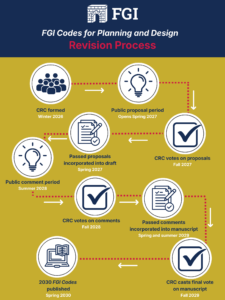
Every four years, FGI undertakes a comprehensive review and revision of the FGI Codes for Planning and Design to ensure they continue to reflect evolving clinical practices, technology, research, and the needs of health and residential care environments.
The revision process is guided by the FGI Code Revision Committee (CRC), a multidisciplinary group of professionals representing the many disciplines involved in planning, designing, constructing, operating, and regulating health and residential care facilities. Through a consensus-based process that includes opportunities for public participation, the CRC evaluates proposed changes and develops the requirements for the next edition of the FGI Codes.
The next edition of the FGI Codes is scheduled for publication in 2030.
The Code Revision Committee (CRC)
Formerly known as the Health Guidelines Revision Committee (HGRC), the CRC brings together professionals with diverse expertise and perspectives, including architects, engineers, clinicians, facility owners and administrators, infection preventionists, researchers, and authorities having jurisdiction (AHJs).
The CRC is organized into three primary document groups, each focusing on one of the FGI Codes:
-
- Hospital Document Group: FGI Code for Planning and Design of Hospitals
- Outpatient Document Group: FGI Code for Planning and Design of Outpatient Settings
- Residential Document Group: FGI Code for Planning and Design of Residential Care and Support Settings
A Steering Committee provides overall direction for the revision cycle, establishing priorities, guiding the committee’s work, and overseeing the revision process.
Additional groups may be formed to address topics that require specialized expertise or consideration across multiple documents. These groups bring together CRC members and subject matter experts (SMEs) to examine specific requirements, evaluate technical information, and develop recommendations for consideration by the appropriate committee groups.
CRC members evaluate proposed changes to the FGI Codes, consider public comments, and participate in the consensus process that determines the content of the next edition.
Professionals interested in contributing their knowledge and experience to the development of the next edition can apply to the 2030 FGI Codes revision cycle CRC until November 29, 2026. Applicants may be considered for CRC membership or invited to serve as SMEs on groups addressing specific topics. Both roles provide important opportunities to contribute to the development of the FGI Codes.
The Steering Committee expects to finalize CRC membership in early 2027, with the first full committee meeting anticipated in May 2027.
Apply here to serve on the 2030 CRC.
Stay Informed and Get Involved
The FGI Code revision process depends on the expertise and participation of professionals throughout the health and residential care community.
Whether you serve on the CRC, contribute as an SME, submit a proposal, or comment on draft revisions, your input helps shape the requirements that will guide future health and residential care facilities.
Subscribe to the FGI Bulletin and follow FGI on LinkedIn for announcements about the 2030 revision cycle, opportunities for participation, and important deadlines.
Subscribe to the FGI Bulletin.
Two Opportunities for Public Input
Opportunities for Public Participation
Public participation is an essential part of the FGI Code revision process. In addition to the expertise provided by CRC members and SMEs, FGI invites professionals and organizations throughout the health and residential care community to contribute their perspectives.
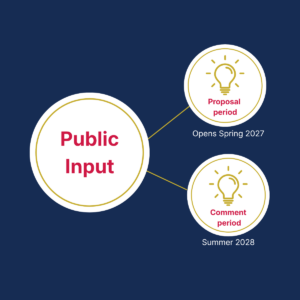
There are two formal opportunities for public input during each revision cycle: the public proposal period and the public comment period.
The Proposal Period
The public proposal period is the first opportunity to recommend changes to the FGI Codes for the next edition.
FGI encourages users of the 2026 FGI Codes to review the requirements and submit proposals identifying language that should be added, revised, or removed. Proposals should clearly describe the recommended change and include substantiation explaining why the change is needed. Supporting research, technical evidence, practical experience, and other relevant information can help the CRC evaluate the recommendation.
Following the close of the proposal period, the CRC reviews submitted proposals and determines which changes will advance into the draft documents. These draft revisions are subsequently made available for public review during the comment period.
The Comment Period
The public comment period provides an opportunity to review changes proposed for the 2030 FGI Codes before the documents are finalized.
During this period, FGI makes the draft revisions available for public review and invites comments on the proposed changes. Participants may recommend modifications to the draft language, provide additional substantiation, or express support for or opposition to proposed changes.
The comment period focuses on revisions developed through the proposal process. New proposals unrelated to the published draft changes generally are not considered during this stage and may be submitted during a future revision cycle.
Following the close of the comment period, the CRC reviews the submitted comments and determines what additional revisions are needed before the documents are finalized.
Final Vote and Publication
Following the public comment period, the CRC completes its review of the proposed revisions and works toward consensus on the content of the next edition. The final review and approval procedures will follow the process established for the 2030 revision cycle.
FGI’s editorial team then prepare the documents for publication.
The 2030 FGI Codes for Planning and Design are expected to be published in Spring 2030.
The completed documents will reflect the contributions of CRC members, SMEs, public participants, and FGI staff working together to advance the planning and design of safe, functional, and effective health and residential care environments.
How the FGI Handbooks Fit into the Revision Process
Beginning with the 2026 edition, FGI publishes two complementary resources: the FGI Codes for Planning and Design and the FGI Handbooks for Planning and Design.
The FGI Codes establish minimum requirements for the planning and design of health and residential care facilities. They are developed and revised through the four-year, consensus-based process described above.
The FGI Handbooks contain the complete text of the corresponding FGI Codes along with explanatory guidance, illustrations, technical information, and other resources that help users understand the intent behind the requirements and apply them in practice.
The FGI Handbooks are digital-only publications that can be updated continuously. This allows FGI to clarify and expand supporting guidance as new information becomes available rather than waiting for the next four-year revision cycle.
CRC members and SMEs contribute their expertise to the development and review of Handbook content, while FGI maintains editorial responsibility and final authority over the advisory material.


Request Sponsorship Information
We appreciate your interest. We'll be sure to email you the sponsorship packet once the information below is submitted.
FGI Facility Code for Hospitals Draft
Refresh this page to download another 2026 draft.
FGI Facility Code for Outpatient Settings Draft
Refresh this page to download another 2026 draft.
FGI Facility Code for Residential Care and Support Settings Draft
Refresh this page to download another 2026 draft.